How to offer custom jewelry without a bench jeweler on staff
Which bench steps can leave your store, three ways to outsource them, ten questions to ask a production partner, and what it costs with a design studio.
By the AurumFlow Production Desk
Published November 13, 2026 · 4 min read
Custom work is where a jewelry store earns its margin and where a store without a bench usually stops. The usual reason is not the design. It is that a custom ring is three jobs, drawn, cast and set, and a store without a bench has nobody to run them. This is how those jobs can leave the store, who ends up answering for them, and what to ask before you hand one over.
What does a bench jeweler do, and which parts can leave the store?
At the bench, a jeweler turns a design into metal: the model is drawn or carved, cast, cleaned up, set with stones, finished and checked. Repairs, resizing and the final fit sit in the same pair of hands. The first four of those can be done somewhere else, by people who do them all day. The rest is the part of the trade a store keeps.
- Work
- Drawing the model in CAD
- Can leave the store?
- Yes
- Who does it with AurumFlow
- Your designer at AurumFlow
- Work
- Casting the piece
- Can leave the store?
- Yes
- Who does it with AurumFlow
- A casting house in the United States
- Work
- Setting the stones
- Can leave the store?
- Yes
- Who does it with AurumFlow
- The same casting house
- Work
- Finishing and inspection
- Can leave the store?
- Yes
- Who does it with AurumFlow
- The casting house, then our QC
- Work
- Consultation, ring size, the hand-over to your client
- Can leave the store?
- No, this is the store’s job
- Who does it with AurumFlow
- You
- Work
- Repairs and resizing of finished pieces
- Can leave the store?
- No, we do not do repairs
- Who does it with AurumFlow
- Your local bench
| Work | Can leave the store? | Who does it with AurumFlow |
|---|---|---|
| Drawing the model in CAD | Yes | Your designer at AurumFlow |
| Casting the piece | Yes | A casting house in the United States |
| Setting the stones | Yes | The same casting house |
| Finishing and inspection | Yes | The casting house, then our QC |
| Consultation, ring size, the hand-over to your client | No, this is the store’s job | You |
| Repairs and resizing of finished pieces | No, we do not do repairs | Your local bench |
What are the ways to outsource, and who answers for the result?
There are three common routes. They differ less in what they cost than in how many parties you manage and who is on the hook when a piece comes back wrong.
- Route
- A freelance CAD artist plus a caster
- CAD
- The freelancer
- Casting and setting
- A casting house you find
- Who answers for the finished piece
- You: two vendors and two quality bars
- Route
- A trade shop
- CAD
- The shop, usually
- Casting and setting
- The shop, or a house it subcontracts to
- Who answers for the finished piece
- The shop, if it does the work itself; ask what it subcontracts
- Route
- A design studio such as AurumFlow
- CAD
- The studio’s designers
- Casting and setting
- Casting houses the studio works with directly
- Who answers for the finished piece
- The studio: one written price and one inspection standard
| Route | CAD | Casting and setting | Who answers for the finished piece |
|---|---|---|---|
| A freelance CAD artist plus a caster | The freelancer | A casting house you find | You: two vendors and two quality bars |
| A trade shop | The shop, usually | The shop, or a house it subcontracts to | The shop, if it does the work itself; ask what it subcontracts |
| A design studio such as AurumFlow | The studio’s designers | Casting houses the studio works with directly | The studio: one written price and one inspection standard |
The first route has the fewest commitments up front and the most work to run: a file that renders well can still fail at the caster, and then it is your problem to carry between two people. The difference between the routes is explained at length in the essay on casting houses, CAD designers and design studios.
Which ten questions should you ask a production partner?
- Is the price fixed and in writing before anything is made? With us: one all-in price for the finished piece, fixed once you approve it.
- Who owns the files? With us: you do, in every format, once the design is paid in full.
- How many rounds of changes are included? With us: one; each further round is $60.
- Who inspects the finished piece, and against what? With us: our QC, against the specification you approved; every stone is counted and the piece is photographed before it ships.
- What happens when a piece fails inspection? With us: it goes back to the bench and comes through the same gate again, rather than shipping with a note.
- What is the lead time, in writing? With us: 1 to 5 business days for the CAD, by complexity, then 5 business days once you approve.
- How are stones handled? With us: stones are chosen with you and priced as their own line.
- Which metals? With us: 14K and 18K, in white, yellow and rose gold.
- How is the piece shipped? With us: tracked, insured shipping with a signature on delivery.
- Who is my one contact? With us: your designer, and one desk behind the order.
What does it cost with AurumFlow?
- Item
- CAD, simple
- Price
- $80
- Note
- 1 business day; a plain band, a bezel solitaire
- Item
- CAD, standard
- Price
- $140
- Note
- 2 business days; a halo, a pavé band
- Item
- CAD, complex
- Price
- $220
- Note
- 5 business days; micro-pavé, a hidden halo, openwork
- Item
- Deposit to start a design
- Price
- $80
- Note
- Per piece; part of the design’s price
- Item
- Further round of changes
- Price
- $60
- Note
- One round is included
- Item
- The finished piece
- Price
- One written price
- Note
- The metal at the day’s gold for the model’s weight, plus the labor
- Item
- Rush
- Price
- +25% of the labor
- Note
- Ask when you order
- Item
- Signed inspection report
- Price
- $35
- Note
- Optional
| Item | Price | Note |
|---|---|---|
| CAD, simple | $80 | 1 business day; a plain band, a bezel solitaire |
| CAD, standard | $140 | 2 business days; a halo, a pavé band |
| CAD, complex | $220 | 5 business days; micro-pavé, a hidden halo, openwork |
| Deposit to start a design | $80 | Per piece; part of the design’s price |
| Further round of changes | $60 | One round is included |
| The finished piece | One written price | The metal at the day’s gold for the model’s weight, plus the labor |
| Rush | +25% of the labor | Ask when you order |
| Signed inspection report | $35 | Optional |
Stones are priced separately, as their own line. Delivery is at the carrier’s rate. There is no minimum order, so a store can start with one piece.
What stays in your store?
- The client relationship and the consultation: what they want, what they can spend, what they are celebrating.
- The ring size, taken and confirmed before modeling starts.
- The final fit and the hand-over, which is where the sale is made.
- Repairs and resizing of finished pieces. We make new pieces and do not do repairs, so keep a bench you trust for that.
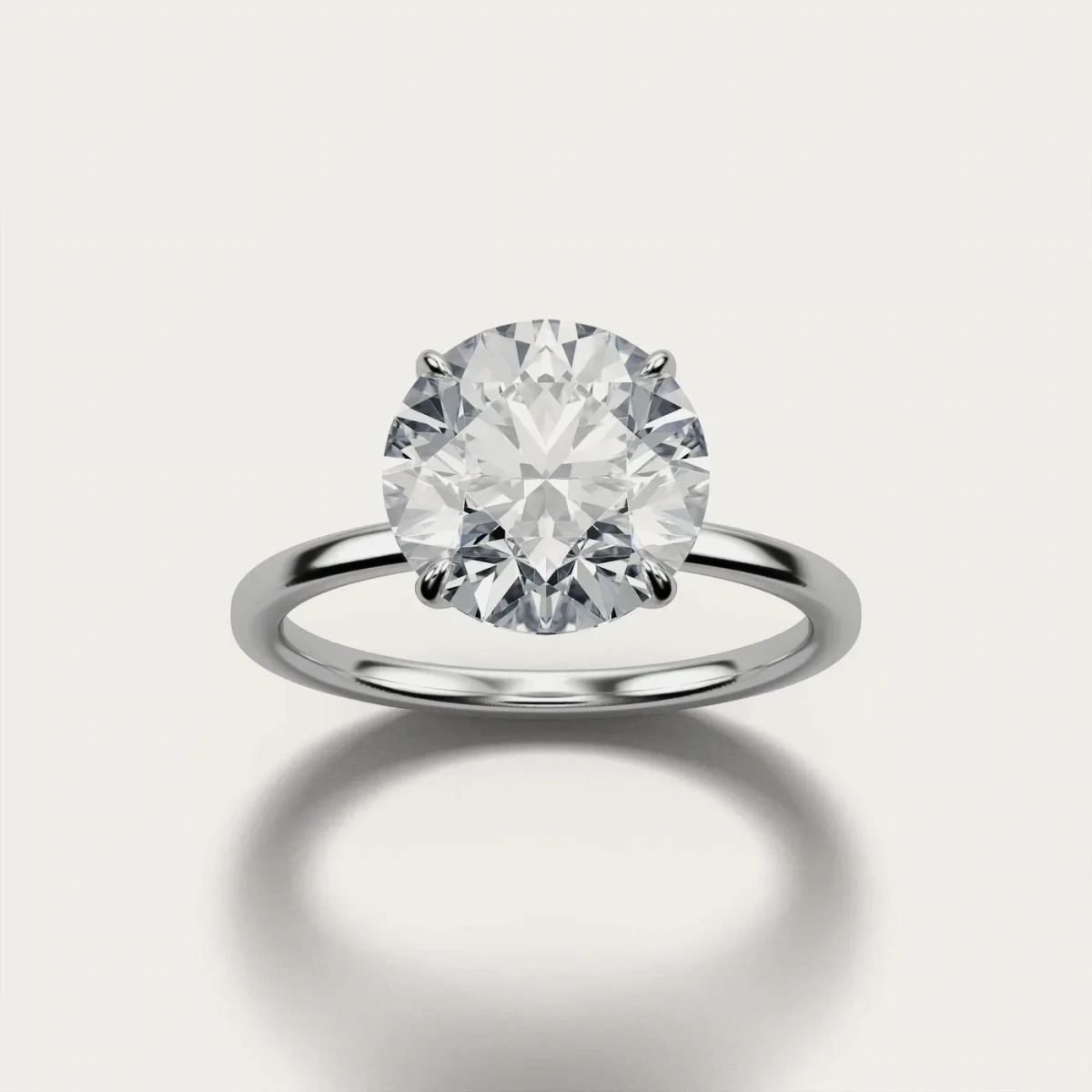
Classic Solitaire — one design, every build
A plain solitaire is where most stores start: one design, drawn once, offered in every stone shape and gold, with the price known before the client commits.
Questions stores ask
- Can a jewelry store sell custom pieces without a bench jeweler?
- Yes. CAD, casting and setting can be outsourced to one partner that answers for all three. The store keeps the client, the ring size, the final fit and the hand-over.
- What do I send to start a custom piece?
- A photo, a sketch or a CAD file, with the ring size and the metal. A photo of something close, with notes on what to change, is faster than a long description.
- Who casts and sets the piece?
- Casting houses in the United States that AurumFlow works with directly. Every piece is inspected against the specification you approved, stone-counted and photographed before it ships.
- How long until my client sees the piece?
- The CAD model arrives in 1 business day for a simple piece, 2 for a standard one and 5 for a complex one. After you approve, the piece is ready to ship in 5 business days. Your review and the carrier’s time come on top.
- Do you repair or resize finished pieces?
- No. AurumFlow makes new pieces. The ring size is settled before modeling, so resizing is rarely needed; repairs stay with a bench you trust.
Written by the AurumFlow Production Desk
The jeweler’s design studio: CAD, casting and setting, one price.