Ring sizing for CAD: the US size chart in millimeters
A size is the one number on a brief that cannot be fixed later. US sizes in millimeters, why a resize is not always possible, and what to send.
Updated September 10, 2026 · 5 min read
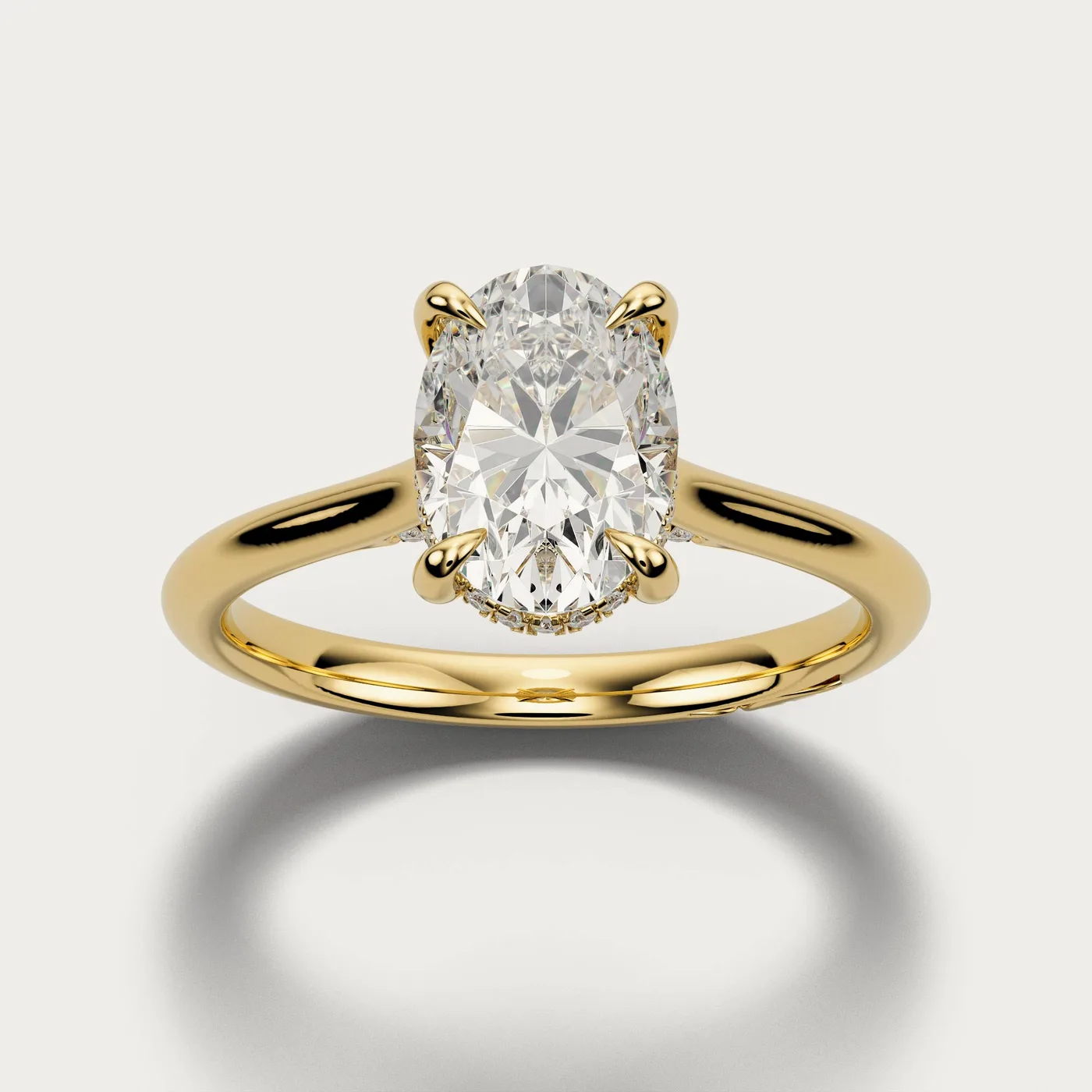
Almost everything on a brief can be changed while the model is open. The metal is a material, not a geometry. The stone shape is a decision the artist expects to revisit. Even the setting style can be swapped in an afternoon before anything is cast. The size cannot, or rather it can, but not for free and not on every piece — and it is the one number most often sent without saying which scale it is on.
This is what to send, what the numbers actually mean in millimeters, and where sizing quietly goes wrong.
Say which scale, or send millimeters
A ring size is not a measurement. It is an index into a national table, and there are several tables. The United States and Canada use a number, sometimes with a half. Britain, Ireland and Australia use a letter. Continental Europe uses the inside circumference in millimeters, so a European "52" is a real measurement and an American "6" is not. Japan uses its own numbering again.
A bare "6" on an order is therefore ambiguous in a way "6 US" is not, and the failure mode is not subtle: a British size 6 is roughly a US 3, which is two and a half millimeters of finger. A model drawn to the wrong table is not slightly wrong. It is a different ring.
US sizes in millimeters
The US scale is arithmetic rather than tradition: the inside diameter starts at 11.63 mm for a notional size zero and grows by 0.8128 mm per size, which is 2.55 mm of circumference. That is why the steps look like odd numbers — they are a conversion from an imperial definition, not a round metric one.
| US size | Inside diameter (mm) | Inside circumference (mm) |
|---|---|---|
| 3 | 14.07 | 44.2 |
| 3.5 | 14.47 | 45.5 |
| 4 | 14.88 | 46.8 |
| 4.5 | 15.29 | 48.0 |
| 5 | 15.69 | 49.3 |
| 5.5 | 16.10 | 50.6 |
| 6 | 16.51 | 51.9 |
| 6.5 | 16.91 | 53.1 |
| 7 | 17.32 | 54.4 |
| 7.5 | 17.73 | 55.7 |
| 8 | 18.13 | 57.0 |
| 8.5 | 18.54 | 58.2 |
| 9 | 18.95 | 59.5 |
| 9.5 | 19.35 | 60.8 |
| 10 | 19.76 | 62.1 |
| 10.5 | 20.16 | 63.3 |
| 11 | 20.57 | 64.6 |
| 11.5 | 20.98 | 65.9 |
| 12 | 21.38 | 67.2 |
| 12.5 | 21.79 | 68.5 |
| 13 | 22.20 | 69.7 |
Why a resize is not always a resize
On a plain band, resizing is a bench job: cut the shank at the bottom, add or remove metal, solder, clean up. An hour, and nobody can tell. This is the picture most people have of it, and it is true of perhaps a third of the pieces we model.
It stops being true the moment there is metalwork at the bottom of the shank. An eternity band cannot be cut at all — there is nowhere without a stone. A half-eternity or a pavé shoulder that runs past the halfway point leaves too little plain metal to work in, and cutting near set stones risks every one of them: heat travels, seats move, and a stone that has shifted a tenth of a millimeter catches the light differently from its neighbors, which is the kind of fault you see across a room.
And there is a proportion problem nobody warns about. Going up two sizes on a solitaire adds about 1.6 mm to the inside diameter and nothing to the head, so the same stone sits on a visibly larger ring and reads smaller. Going down two does the reverse and can crowd the gallery against the finger. Beyond about a size and a half either way, the piece wants to be re-modeled rather than resized, which is the whole argument for getting the number right the first time.
Where the measurement itself goes wrong
- Cold hands. A finger measured in a January doorway can read half a size under what it will be in July. Measure warm, and at the end of the day rather than the start.
- Wide bands. A 2 mm band and an 8 mm band do not fit the same. Anything above about 6 mm wants a quarter to a half size up, because the band bears on more of the finger and has less room to flex over the knuckle.
- The knuckle. The size that matters is the larger of the finger and the knuckle it has to pass. On a pronounced knuckle the ring will spin, and the answer is a sizing bead or a slightly flattened inner profile, decided in CAD rather than afterwards.
- Plastic sizers. The cheap strips read small, because they are thin and flex over the knuckle in a way metal will not. A steel sizing set in the width of the actual band is the only measurement worth trusting for a piece being made once.
- Measuring a ring the client already wears. Fine, if you also say which finger and which hand it is worn on — the dominant hand usually runs a quarter to a half size larger.
Do not chase a quarter size
A half size is 0.41 mm of diameter. A quarter is 0.20 mm. Fingers change by more than that over a hot afternoon, and the sizing tools most benches own do not resolve below a quarter honestly. Specifying to a quarter is worth doing on a wide band or a tension setting, where the fit is structural, and is false precision on almost everything else.
What to put on the order
- The number and the scale: "US 6.5", not "6.5".
- The inside circumference in millimeters, if you have it. It overrides everything else and cannot be misread.
- The band width you have in mind, because it changes the size the client should be measured at.
- Whether this piece has to sit against another — a wedding band, a stacking set. Two rings worn together fit differently from either one alone, and the pair should be modeled as a pair.
- Whether the design has stones low on the shank. If it does, the size is being decided permanently, and everybody involved should know that at the point of ordering rather than at delivery.
A model is drawn to whatever size you name, and drawing it to a different one costs nothing while it is still a file. That is the cheapest moment this decision will ever have, and it is the reason it is worth five minutes of measuring rather than one minute of guessing.
Every file described here is delivered with the model, and yours to keep.