Prong, bezel, pavé: how to choose a stone setting
A setting decides how much light gets in, how safe the stone is, and how much bench time the piece costs. Six kinds, and who each one suits.
Updated August 7, 2026 · 5 min read
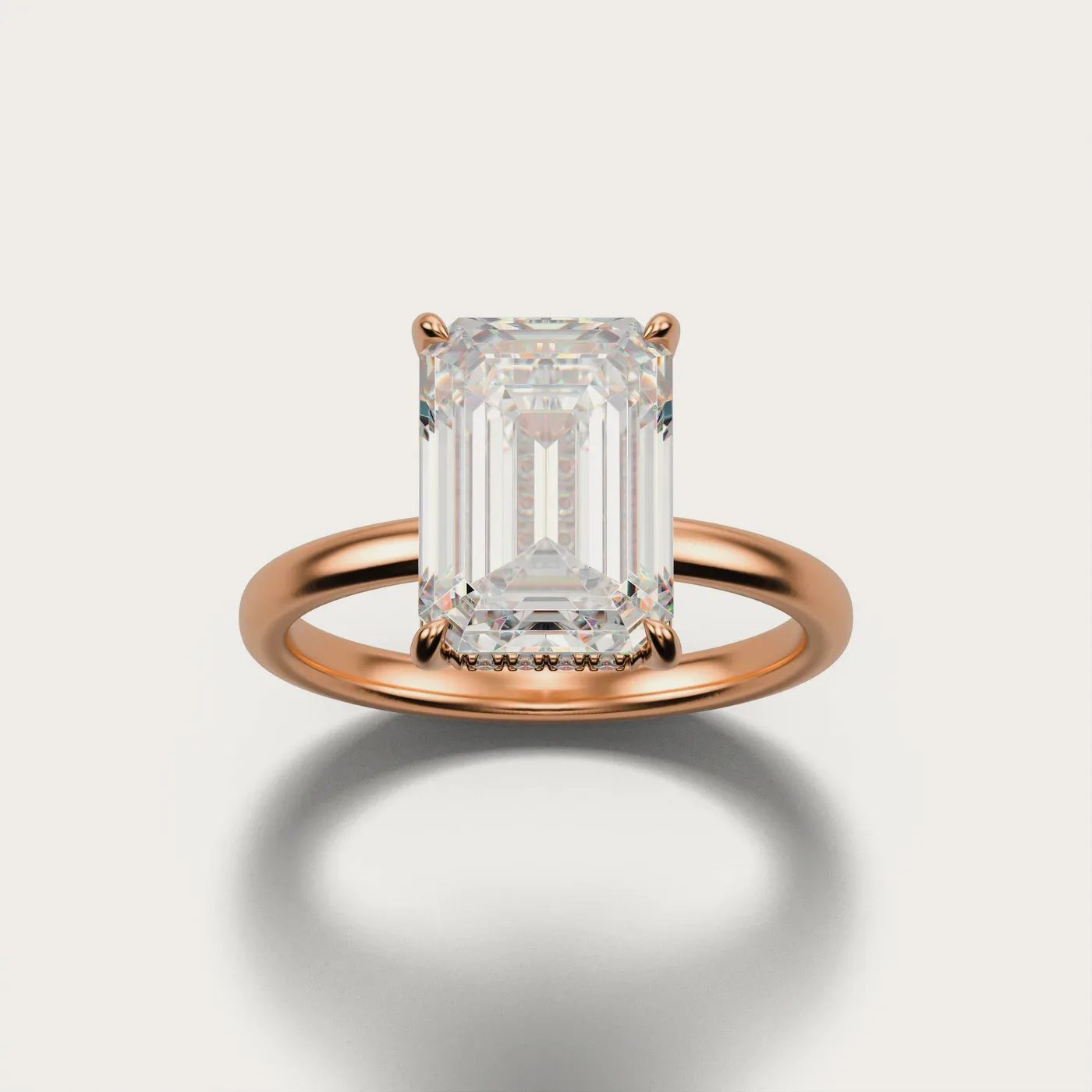
A setting is three decisions wearing one name. How much light reaches the stone and comes back out. How exposed the stone is to the ten thousand small collisions of a life. And how many hours at a bench the piece costs, which is the one nobody mentions until the quote arrives. Those three pull against each other, and every setting style is a particular compromise between them.
These are the six we set, what each is actually good at, and who it suits.
Prong
Four or six claws lift the stone clear of the metal so light can reach it from the sides as well as the top. It is the classic because it works: minimum metal, maximum brilliance, and the stone sits where it can be seen from every angle.
The cost is exposure. Prong tips are the thinnest metal on the ring and they are the part that catches on wool, lifts, and eventually wears down. They are also the reason a ring should be looked at every year or two by somebody who will re-tip them before a stone moves rather than after.
Six prongs hold more securely and hide slightly more stone than four. Four is cleaner and shows more of the girdle. On a pointed shape — pear, marquise, heart — the point needs a V-prong over it, because a tip left proud is a tip that chips.
Bezel
A continuous rim of metal wraps the girdle. It is the most protective setting there is: nothing to catch, nothing to lift, and the edge of the stone — where it is most fragile — is covered completely.
It costs light and it costs apparent size. Less of the stone is visible and less light enters from the side, so a bezel-set stone reads smaller and quieter than the same stone in prongs. Whether that is a loss depends entirely on whether you wanted quiet.
Halo
A ring of small stones around the center. It makes the center read larger, adds a great deal of sparkle at a fraction of what the same visual size would cost in one stone, and gives a modest center presence it would not have alone.
It also commits you to a look, and it multiplies the number of stones that can loosen. A hidden halo — set underneath, facing sideways rather than up — is a quieter version of the same idea: from above the ring is a solitaire, and the detail only appears in profile. It is our own most-photographed design for a reason.
Pavé and micro-pavé
Many small stones set close together, held by tiny beads of metal raised from the surface, so the metal reads as a continuous field of light. Done well it is the most impressive thing a setter does. Done badly it is a row of stones with gaps and a shank that snags.
It is hand-work, and it is the thing that moves a piece into the top complexity band both to model and to make. Every seat is cut individually, every bead is raised individually, and there is no version of this that goes faster.
Channel
Stones sit in a groove between two walls of metal, held by the walls rather than by beads or claws. Nothing protrudes, so nothing catches — which makes it the durable choice for a band that will be worn next to another ring and rubbed against it daily.
It asks for stones of consistent size, because the channel is one continuous line and any variation in the row is visible along its whole length. It is also harder to resize afterwards than a plain shank, which is worth knowing before it is engraved and sized.
Tension
The stone is held by the spring of the metal itself, pressing on two points of the girdle, apparently floating in the gap. It is the most striking of these and the most demanding: the shank has to be worked to hold a precise tension, and the piece is genuinely difficult to resize afterwards without redoing the setting.
It suits a hard stone and a wearer who wants exactly this and nothing else. It does not suit a stone with cleavage planes or a ring likely to change hands and sizes.
What setting costs, and why it is per stone
Setting is charged per stone, not per hour. That is not an accounting preference — it is how the work actually behaves: each seat is cut and each bead is raised as its own small job, so forty accent stones is forty of them. A quote built on hours would be a guess about a setter’s day; a quote built on stones is a count, and you can do it yourself.
The practical consequence is that a halo or a pavé shank changes the price of a piece more than most people expect, and swapping four prongs for six changes it almost not at all. If a budget is tight, the number of stones is the lever.
How settings fail
Almost always in one of three ways, and all three are checked before a piece leaves us: a seat cut too shallow, so the stone sits proud and rocks; uneven tension across the claws, so one is doing the work of three; and beads raised without enough metal behind them, which is a pavé stone waiting to leave.
That last one is decided in CAD rather than at the bench — if the model did not leave enough metal between the seats, no amount of skill at setting rescues it. It is the most common reason a beautiful render turns out to be an unmakeable piece.
A piece that fails on any of these goes back to setting rather than forward to shipping. There is no route from our quality gate to a client that passes through "close enough".
Choosing, briefly
- Maximum light on the stone, classic look, accepts maintenance — prong.
- Hands-on life, or a stone worth protecting more than displaying — bezel.
- A modest center that needs presence, or a budget that has to look bigger — halo, or a hidden halo if you want the front to stay plain.
- Continuous sparkle along the shank, and the bench time to pay for it — pavé.
- A band worn beside another ring, every day, for years — channel.
- You want the stone to appear to float and you are certain — tension.
Every file described here is delivered with the model, and yours to keep.