From sketch to castable CAD: what really happens
A model isn’t “done” when it looks right — it’s done when it can be cast. Here’s the quiet checklist between a drawing and a file a house will accept.
AurumFlow
April 19, 2026 · 4 min read
The distance between a sketch and a production file is mostly invisible work: the decisions that make a piece manufacturable rather than merely beautiful on screen. None of it is visible in the finished render, which is why it is so easy to assume it did not take long.
A drawing is a wish. A model is a commitment
A sketch can be ambiguous and still be a good sketch. It can show a shoulder that tapers “a bit”, prongs that are “fine and not too heavy”, a halo drawn as a ring of circles that are roughly the same size. That vagueness is not sloppiness — it is what a sketch is for. It captures intent without committing to numbers.
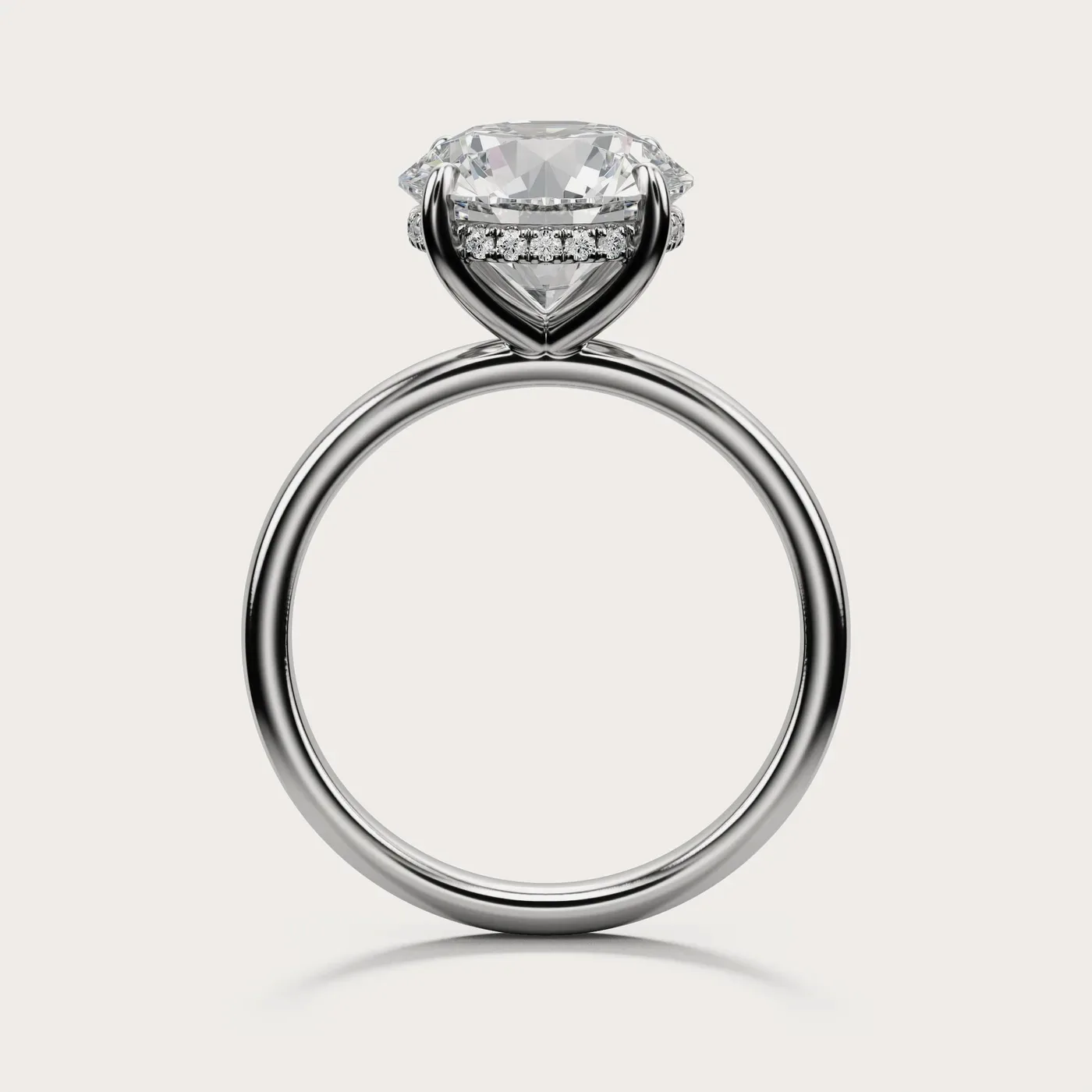
A model cannot do that. Every one of those decisions has to become a figure: the shoulder tapers from 2.4 mm to 1.8 mm, the prongs are 0.9 mm at the base and sit at these four angles, the halo is sixteen stones of 1.2 mm with 0.35 mm of metal between the seats. The modeler does not get to leave anything vague, because the mill or the printer will not.
That translation is most of the job, and it is why a good modeler asks questions that feel pedantic. They are not being difficult. They are being asked to commit, on your behalf, to a number you did not give them.
Walls, seats and clearances
Wall thickness has to survive casting and wear — thick enough that molten metal reaches the end of it before freezing, and thick enough that a decade of contact with door handles does not wear through. Those are different thresholds and the larger one wins.
Stones need proper seats, not holes. A seat is a bearing cut to the girdle of the specific stone that is going in, at a depth that puts the table where the design wants it. A hole with a stone resting on top is what a render looks like when nobody has thought about setting, and a setter will cut the seat properly at the bench — once, cheerfully, and then at cost across a run.
Prongs need enough metal to hold and to last, which is more than enough metal to look right. A gallery has to clear the finger, and it has to clear it when the wearer’s hands are warm at the end of a day rather than at the size they were measured at. None of this shows in a thumbnail, and all of it decides whether a piece can be made.
The parts nobody draws
A sketch never shows a sprue. Every casting needs one — a channel where metal enters and air leaves — and where it attaches is a real decision: it wants to feed the heaviest section, it wants to be somewhere the scar can be finished away, and it must not cross a surface that has to stay crisp.
A sketch never shows the inside, either. Hollowing a heavy piece to save gold is good practice; hollowing it without leaving the inside a way to drain is a sealed void that traps investment and ruins the casting. And a sketch has no opinion at all about whether the surface is closed, which is the one property that decides whether the piece can even be weighed.
These are the parts that separate a model made to be looked at from a model made to be made. We have written about the failures themselves in more detail in a guide on castability; the point here is that somebody has to be thinking about all of it while drawing something that is supposed to look effortless.
Castability QA
Before a model reaches a client or a house, it is checked against real limits — minimum walls for the metal it will be cast in, stone seat depth, prong geometry, finger-size accuracy, whether the mesh is closed. If it cannot be cast, it does not move forward.
That single gate prevents most of the failures that show up at the bench, and the reason it works is that it happens while changing something is still cheap. A wall corrected in CAD costs a revision. The same wall corrected after casting costs the casting, the metal, the setter’s time and the date you promised somebody.
Why it looks like it took no time
The finished model shows none of this. It looks like the sketch, which is the goal — a client should recognize their drawing, not a compromise with physics. The work that made it manufacturable is invisible precisely because it succeeded.
It is worth knowing it happened, though, if only to recognize what you are choosing between. A file produced without any of it will also look like the sketch, right up until somebody tries to cast it.
Written by AurumFlow
The managed platform for jewelry production.