How many renders it takes to sell a piece — and which ones
Four cameras, every metal, and why a set lit three different ways reads as three different studios. What to show a client, and what to skip.
Updated August 7, 2026 · 4 min read
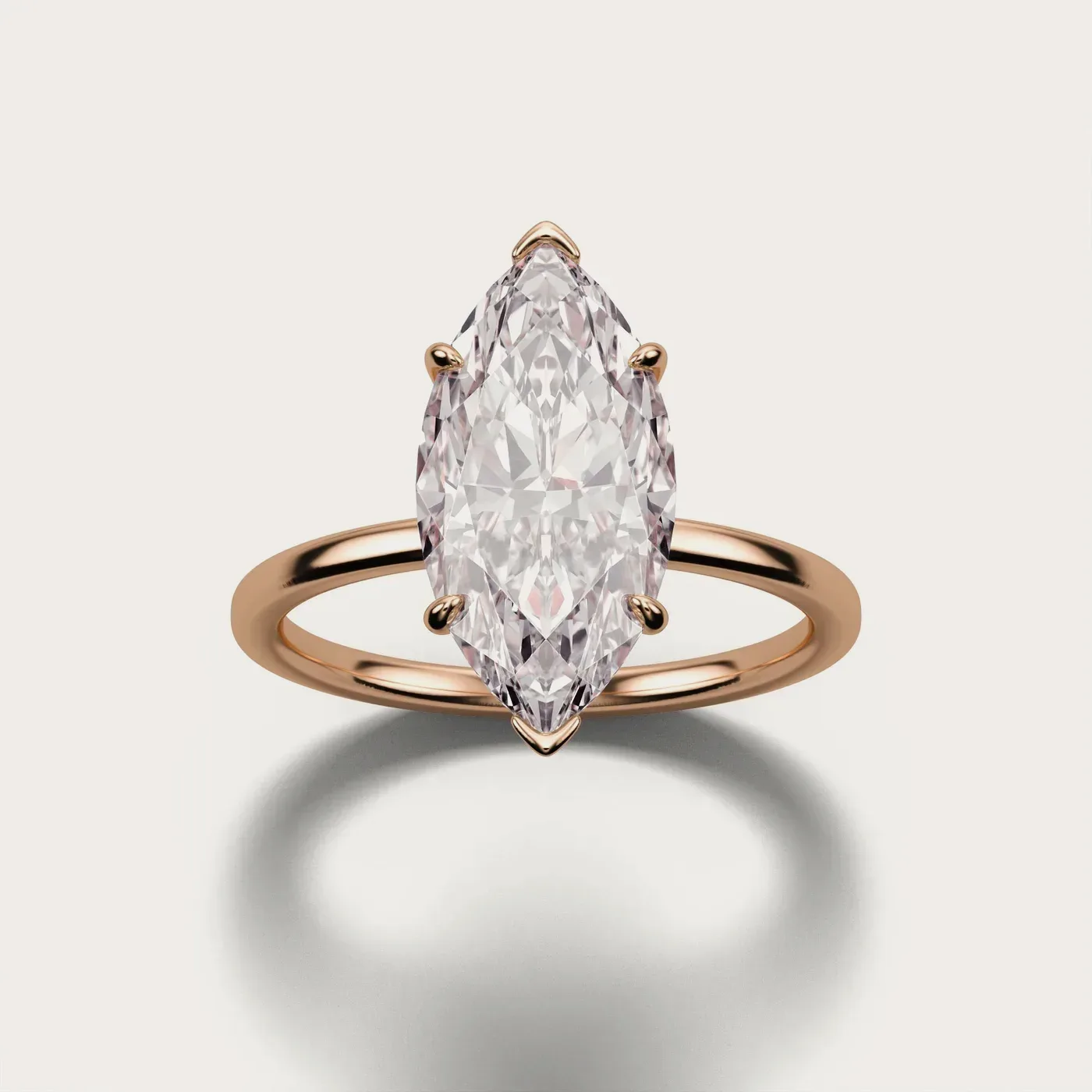
A render is not a picture of a ring. It is the thing a client says yes or no to, weeks before anything is cast — so the question is never "is this beautiful", it is "does this answer what they are about to ask". Get that right and four images close a sale. Get it wrong and thirty do not.
The four cameras, and what each one settles
Almost every piece can be sold from four views, and each of them exists to answer a different question.
- Three-quarter — the hero. It is the only view that shows the face and the profile at once, which is why it is the one that goes first everywhere.
- Front — the view a client pictures when they imagine it on a hand. It settles proportion: how big the stone reads against the band.
- Side — the profile, and the one that answers questions nobody asks out loud. How high does it sit. Will it catch on a sleeve. Is there a gallery under there.
- Top — the one that sells the setting. Prong count, the halo, how the pavé runs. It is also the view most likely to expose a design that is prettier than it is resolved.
One model, every variant
This is the part that changes the economics rather than the pictures. Once a piece is modeled, showing it in a second metal costs a render, not a sample. So does a second stone shape. A line that would take a display case of physical pieces to present can be shown complete, and none of it has to exist first.
It is worth being concrete about the scale of that. One solitaire in our own catalog is offered in thirteen stone shapes and three metals — thirty-nine buildable pieces, photographed from four cameras each. A hundred and fifty-six images, from one model, of a piece nobody has cast. Making thirty-nine samples to photograph them is not a smaller job, it is a different business.
Consistency beats any single image
A client does not judge one render. They scroll a row of them, and the row is what they judge. If those images were lit and graded separately — different sweep, different white balance, different shadow — the row reads as three photo sessions someone stitched together, and the pieces look like they came from three different workshops.
We learned this the tedious way on our own catalog. Renders that each looked correct alone sat on backdrops running from warm to cool, and inside a grid every one of them showed as a faint rectangle of its own. Every render now gets measured and put on one house tone, and because scaling each color channel to hit that tone is a white balance, the metal agrees across the whole set too. The individual images barely changed. The page stopped looking like three studios.
What to show, by what it is for
- A product page — the three-quarter, plus the metal options. Front and side underneath for the people who scroll, because those are the people who buy.
- A commission presentation — the three-quarter in the metal they chose, and the side view. The side is what stops a client being surprised by the piece in their hand.
- A wholesale line sheet — one camera, every piece, identical framing. Consistency is the entire product here; variety is noise.
- Social — the three-quarter, and a turntable if the piece has a profile worth turning. A flat band does not.
Turntables, cut-outs and when they earn it
A turntable is worth its cost when the piece has something to reveal as it moves — a hidden halo, an openwork gallery, a shank that changes shape. On a plain solitaire it is a slower way to show the same thing. Cut-outs on transparent backgrounds are worth asking for when the images are going into somebody else’s template and you do not control the background they will land on.
What it costs
By the set, and quoted by a person. There is no table for rendering on our pricing page, and the honest reason is that the sets people actually ask for vary too much for one to be true: a single piece in three metals and a fifteen-piece campaign with lifestyle scenes are not the same job with a different number in front of it. Tell us what has to be shown and to whom, and the quote follows.
Every file described here is delivered with the model, and yours to keep.